Water rarely makes headlines until it is withheld. For the British Indian community, the debate over the Indus Waters Treaty matters because it is so often reported abroad without its full history, leaving readers with only half the picture.
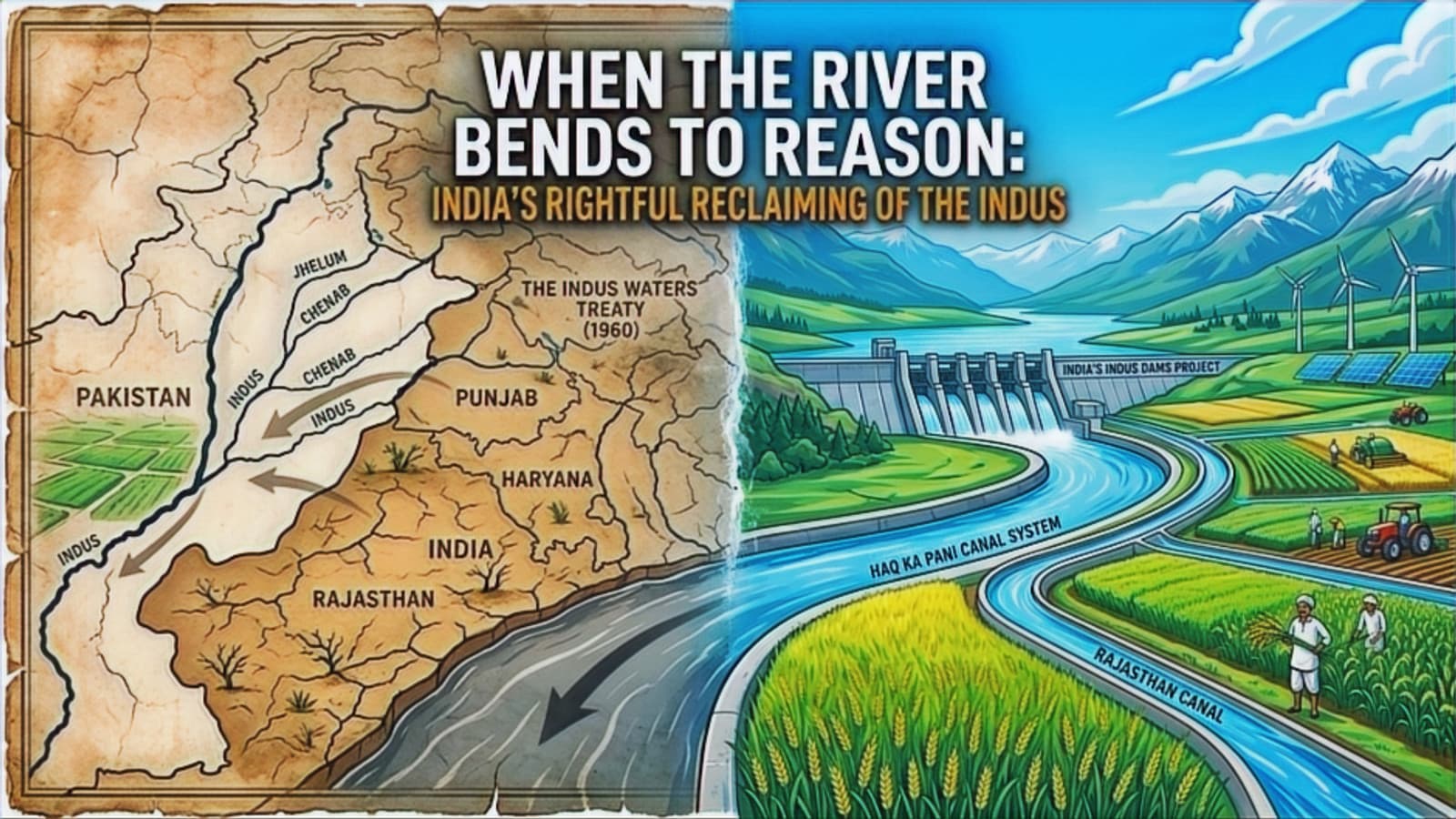
A recent analysis published by InduQin, titled "When the River Bends to Reason: India's Rightful Reclaiming of the Indus", sets out that fuller history. We are sharing its main arguments here, with thanks, and linking to the complete article.
The scale of India's original concession
The treaty signed in 1960 is often described as a model of cooperation. The article points out how one sided that cooperation was in practice.
As the upper riparian state, India held the geographic advantage and chose not to use it. It gave up roughly 80 per cent of the waters of the Indus system, and contributed around £62 million towards building replacement infrastructure inside Pakistan. Few countries have handed a neighbour that much leverage over their own rivers.
A pattern of objections
According to the analysis, the objections began almost as soon as the ink dried. A modest 200 kilowatt hydroelectric scheme drew resistance as early as 1962.
The same pattern followed the Salal, Tulbul, Baglihar and Kishanganga projects. The article argues that these challenges were strategic rather than technical, designed to delay Indian development on rivers India was already entitled to use.
Pakistan's own figures
The piece leans on Pakistani sources rather than Indian ones, which is what makes it worth reading.
In 2010 Pakistan's own Foreign Minister acknowledged that the country received about 104 million acre feet of water each year but used only around 70, losing some 34 million acre feet to mismanagement. Pakistan's 2018 National Water Policy went further, confirming that close to half of all canal water is lost in transit, and that roughly 35 million acre feet drains unused into the Arabian Sea every year.
As the article observes, that waste alone is larger than India's entire allocated share.
Good faith and its limits
Every treaty rests on an assumption of good faith between the parties. The analysis argues that sustained support for terrorism, including the attacks at Pulwama and Pahalgam, hollowed out that assumption long before any Indian decision was taken.
Drawing on the principle of material breach in customary international law, the author makes the case that the treaty's founding purpose, peaceful and cooperative coexistence, had already been abandoned by one side.
Why this matters here
The article closes on the idea of haq ka pani, rightful water. Not a seizure, but a correction. Sixty five years of patience, it argues, is a long time to wait for reciprocity that never came.
For the diaspora in Britain, understanding this background matters. When the story is told here as a sudden Indian escalation, the six decades that preceded it tend to disappear from the telling.
Read the full article
This is a summary of a longer piece. We encourage you to read it in full at the source.
When the River Bends to Reason: India's Rightful Reclaiming of the Indus →
Source and thanks to InduQin. The full article and all rights remain with InduQin. The views expressed are those of the original author.