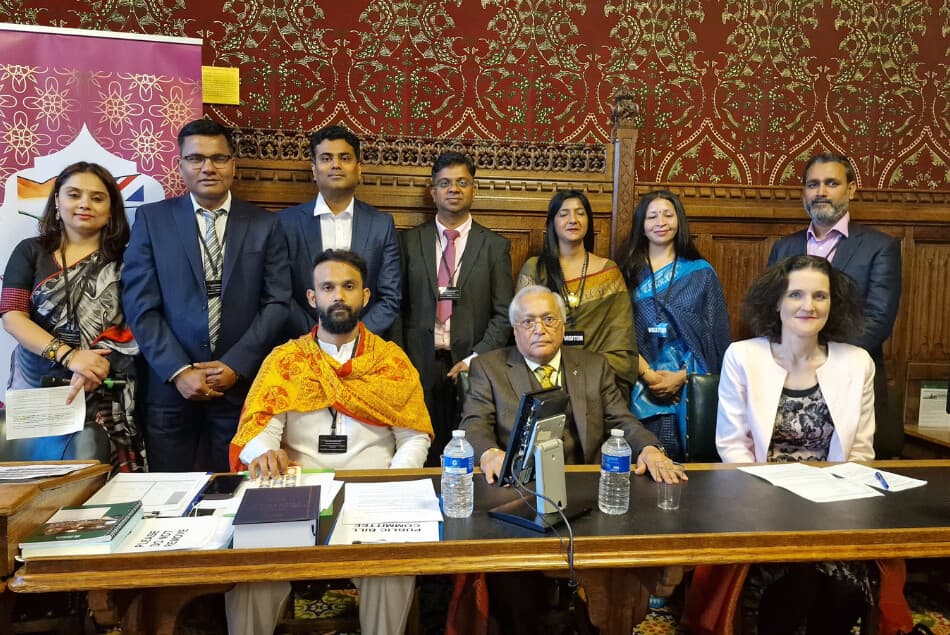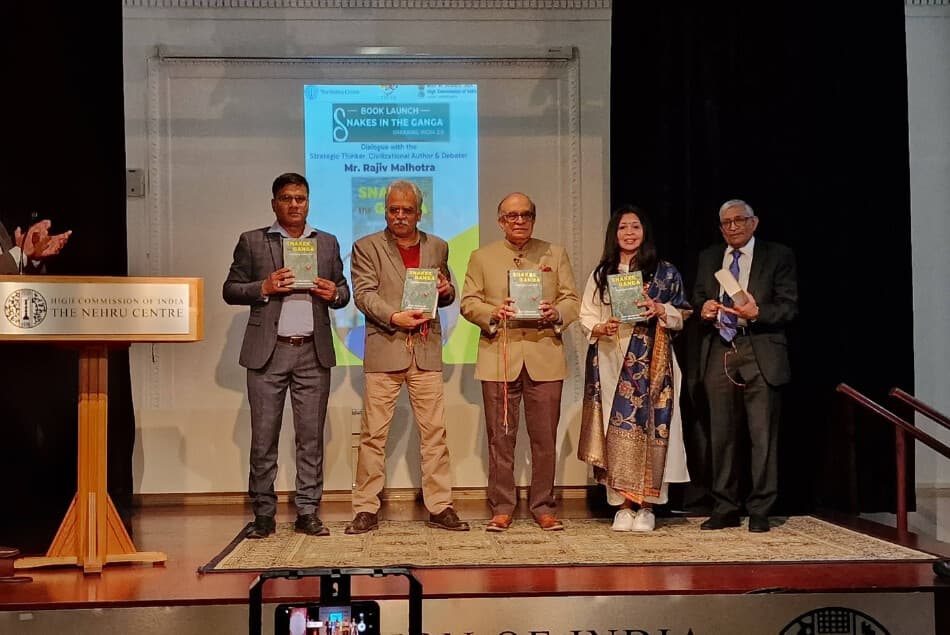
This article has been curated from the keynote address by Manoj Ladwa on the occasion of Friends of India Society International (FISI) UK's Golden Jubilee on 28 June 2026 at The Bhavan, London.
50 years is more than an anniversary. It is an opportunity for an institution to examine what it inherited, what it defended, what it built and what it must now pass on.
For Friends of India Society International UK, those questions carry particular weight.
FISI was founded in 1976, during one of the most difficult periods in India's democratic history. The Emergency tested the country's institutions, restricted civil liberties, censored the media and imprisoned political opponents. For Indians living overseas, including in Britain, this was not a distant political episode. It was a direct challenge to the democratic idea of India.
Those who spoke out understood an important distinction: to be a friend of India is not to be uncritical of whichever government holds office. It is to stand with India's people, its democratic institutions, its civilisational confidence and its long-term future.
That was FISI's moral foundation. It began as a partner in protest, defending the principle that India's strength lies not only in its history, scale or civilisation, but in its ability to renew itself through freedom.
The challenge today is different.
If FISI's first chapter was shaped by protest, its next must be defined by progress. The task is to move from defence to delivery, from emotional solidarity to structured partnership, and from preserving memory to shaping outcomes.
Institutionalising the UK–India Opportunity
Across three decades of working within the UK–India corridor, I have had the opportunity to engage political leaders, investors, founders, academics and young people in both countries.
The clearest lesson from that experience is that goodwill, while valuable, is not sufficient. Relationships must be organised, trust must be institutionalised and ambition must be matched by execution.
This matters because India is no longer at the margins of the global economic story. It is increasingly helping to write it.
The most significant change is not simply visible in India's growth figures, technological capacity or geopolitical influence. It is reflected in the confidence with which India now engages the world, and in the seriousness with which the world engages India.
India is now a country governments, businesses and investors actively seek to partner with.
The UK–India bilateral agenda now spans trade, investment, artificial intelligence, clean energy, health, science, advanced technology and national security. The agreements and political declarations create a framework, but frameworks do not implement themselves.
Someone must organise the capital, expertise, institutional relationships and commercial partnerships required to convert political intent into measurable results.
That is where communities and institutions such as FISI have an opportunity to become more consequential.
Beyond the Diaspora
The British Indian community will always be central to the relationship between India and the United Kingdom. It is one of Britain's most accomplished communities, with influence across Parliament, business, medicine, academia, technology and public life.
But the next stage of India's global engagement requires a wider circle.
The friends of India in Britain are not only people of Indian origin. They include entrepreneurs who see India as the commercial opportunity of their generation; scientists seeking research and technology partnerships; investors looking for growth, scale and innovation; regional leaders who want their cities and industries connected with Indian states; and young people whose first encounter with India may come through culture, travel, food or sport, but whose engagement can develop into something deeper.
Prime Minister Narendra Modi has very eloquently described the Indian diaspora as a living bridge between nations. That is an important idea. The opportunity now is to connect those bridges into networks: networks of talent, capital, research, enterprise, policy and trust.
The diaspora should not be viewed only through the lens of identity or sentiment. It is a form of strategic capital.
Its real value lies in execution capacity across borders: the ability to understand two systems, interpret one to the other, reduce friction and bring together people who may not otherwise collaborate.
That is the difference between presence and influence.
Individual success is important, but success and significance are not the same. Success is entering the room. Significance is helping to shape what happens inside it.
The next generation of British Indians must aim not only to participate in institutions, but to build and lead them.
Heritage as Strategic Memory
FISI's work to document the history of Indians in Britain, including through its Bharat in the UK heritage initiative, is therefore not peripheral to its future. It is central to it.
Heritage should not be confused with nostalgia. Properly understood, it is a form of institutional memory.
It tells younger generations that they did not arrive from nowhere. Their opportunities were created by those who came before them: people who built businesses, places of worship, cultural institutions, community organisations and professional networks, often in difficult and unwelcoming circumstances.
Recording that experience gives a community confidence. It also places the Indian contribution where it belongs: not as a footnote to modern Britain, but as part of Britain's national story.
The task, therefore, is not only to preserve this heritage, but to make it visible and useful through schools, museums, digital platforms and intergenerational engagement.
A strong understanding of history should not trap a community in the past. It should give it the confidence to build the future.
India Needs Thoughtful Friends
India is too serious a democracy and too significant a civilisation to require applause. However, a community that applauds every decision eventually loses credibility, because its advocacy is assumed rather than earned.
There is an important difference between an advocate and a megaphone.
A megaphone repeats. An advocate understands.
Serious advocacy requires command of facts, policy and context. It means correcting genuine misunderstanding with evidence rather than volume. It means defending India when it is unfairly attacked, while also retaining the credibility to ask difficult questions when necessary.
That is not disloyalty. It is mature partnership.
India's friends should celebrate its achievements specifically, explain its complexities honestly and defend its interests authoritatively.
They should be friends of India's people, friends of its democracy and active partners in its future.
Turning Stability into Leadership
The responsibility is particularly important for younger generations.
Their grandparents turned survival into stability. Their task is to turn stability into leadership.
That means not only entering established professions, but shaping them. Not only being employed, but building companies and institutions. Not only celebrating India's rise, but participating in it through investment, innovation, public service and entrepreneurship.
A British Indian identity, held with confidence and maturity, is an advantage.
The ability to move between cultures, institutions and markets will become increasingly valuable in a world where economic growth depends on cross-border collaboration and trusted relationships.
Young British Indians can be proudly British and deeply connected to India. They can serve Britain while strengthening its partnership with India. They can honour their heritage without becoming imprisoned by it.
But established organisations must make room for them seriously. That means responsibility, mentoring, decision-making authority and the freedom to make mistakes.
Without renewal, institutions become commemorative. With renewal, they remain consequential.
The Next Fifty Years
The founders of FISI answered the call of their time.
Their moment demanded protest. Ours demands progress.
Their moment required India's democracy to be defended. Ours requires India's rise to be understood, supported and connected to the world through capital, technology, policy and long-term partnerships.
The best way to honour the founders is not simply to preserve what they created, but to renew it for the age ahead.
FISI's Golden Jubilee should therefore be remembered not only as a celebration of its past, but as a turning point. It should mark the moment when the organisation widened the circle of India's friends, connected heritage with the next generation and translated goodwill into enduring institutional value.
Fifty years from now, when another generation gathers to mark FISI's centenary, the measure of this period will not be how often the community was celebrated. It will be whether it was consequential.
Did it mobilise investment? Did it build institutions? Did it strengthen Britain's partnership with India? Did it create opportunities for those who followed? Did it help convert India's growing global relevance into shared prosperity and lasting cooperation?
India does not need passive admirers. It needs thoughtful friends. Britain does not need sentimental nostalgia. It needs strategic partnership. And the world does not need more fragmented conversations. It needs trusted platforms capable of turning dialogue into decisions, relationships into investment and shared ambition into durable outcomes.
The journey from partners in protest to partners in progress is therefore more than a theme for an anniversary.
It is the responsibility of our time.
Manoj Ladwa is the founder and chairman of India Global Forum.